
High-Efficiency Powder Production Utilizing the MTW Series European Type Grinding Mill
1. Introduction: The Critical Role of Limestone in Emission Control
Flue Gas Desulfurization (FGD) has become a global industrial standard for coal-fired power plants and steel manufacturing facilities to mitigate sulfur dioxide (SO2) emissions. Among various technologies, Limestone-Gypsum Wet FGD and In-furnace Calcium Injection are the most widely adopted due to their high reliability and cost-effectiveness. The chemical efficiency of these systems is fundamentally dependent on the quality of the desulfurization medium: limestone powder (CaCO3).
The reactivity of limestone powder is governed by its purity and, more importantly, its particle size distribution. For wet FGD systems, the powder must typically reach a fineness of 250 to 325 mesh (90% passing) to maximize the contact surface area between the slurry and the flue gas,. To meet these rigorous industrial demands, the MTW Series European Type Grinding Mill offers a specialized, high-capacity, and energy-efficient solution for limestone preparation.
2. Theoretical Basis of Limestone Desulfurization
In the Wet FGD process, limestone powder is mixed with water to form a slurry. When flue gas passes through the absorber tower, SO2 reacts with the calcium carbonate to form calcium sulfite, which is then oxidized into gypsum. In In-furnace Calcium Injection, pulverized limestone is injected directly into the combustion chamber, where it decomposes into CaO and reacts with SO2 at high temperatures.
Regardless of the method, the surface area-to-volume ratio of the limestone powder is the primary driver of the reaction rate. Larger particles fail to react completely, leading to “limestone blindness” and increased reagent costs. The MTW Series is engineered specifically to provide the precise particle size control required to ensure near-complete chemical utilization.
3. Core Technology: MTW Series European Type Grinding Mill
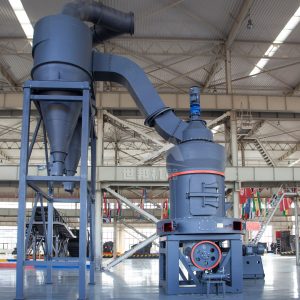
The MTW Series (MTW115G to MTW218G) represents the pinnacle of industrial grinding technology, developed through extensive R&D and feedback from thousands of global installations. It integrates several patented innovations that make it superior to traditional Raymond mills or ball mills for limestone processing.
3.1 Curved Shovel Design for Enhanced Efficiency
Unlike traditional straight shovels found in older grinding equipment, the MTW utilizes a curved shovel design. This innovation increases the effective working area within the grinding chamber. By guiding the limestone into the gap between the rollers and the ring more effectively, it ensures a higher throughput and reduces the internal circulation of material, which significantly boosts production efficiency,.
3.2 High-Efficiency Cage Separator
The precision of the final product is managed by a cage-type separator. This component uses frequency conversion to adjust the fineness from 1.6 mm down to 0.038 mm (equivalent to 400 mesh),. The cage design provides high classification precision, effectively preventing “coarse powder leakage”—a common issue where oversized particles enter the final product and degrade desulfurization efficiency.
3.3 Thin Oil Lubrication System
Reliability is paramount in power plant environments where the desulfurization unit must operate 24/7. The MTW series replaces traditional grease lubrication with an internal thin oil lubrication system,. Thin oil offers lower resistance during operation, maintains lower bearing temperatures, and extends the service life of critical components. This ensures that the limestone preparation line has a higher “up-time” compared to systems that require frequent stops for manual greasing.
3.4 Non-resistance Volute and Energy Optimization
To reduce the energy footprint of the plant, the MTW features a non-resistance volute design. This allows the airflow to move tangentially through the system with minimal turbulence. By reducing air resistance, the fan motor consumes less power to maintain the necessary airflow for material transport, resulting in substantial long-term energy savings.
4. System Working Principle and Process Flow
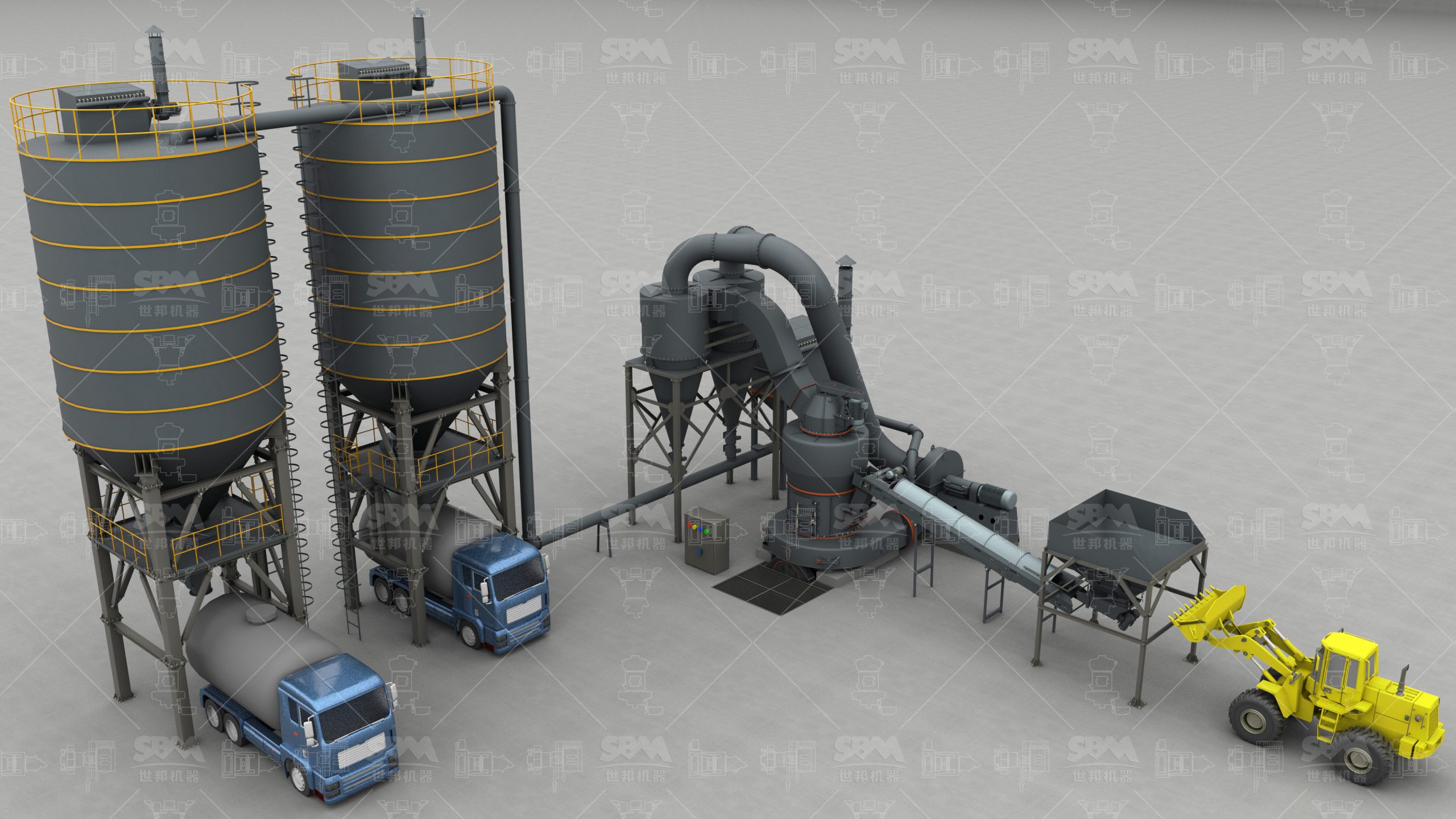
The MTW limestone preparation solution operates as a closed-circuit cycle, maintaining a clean, dust-free environment through a combination of positive and negative pressure.
- Crushing Phase: Raw limestone (typically 0-50mm) is fed into a crusher to reach the optimal feed size for the mill (35-50mm depending on the MTW model),.
- Feeding Phase: An elevator lifts the crushed limestone into a storage hopper. An electromagnetic vibrating feeder (such as the GZ series) uniformly delivers the material into the grinding chamber, ensuring a stable material bed,.
- Grinding Phase: Inside the MTW mill, the rotating rollers exert centrifugal force against the stationary ring. The material is caught between them and pulverized into fine powder.
- Classification Phase: The blower directs a strong upward airflow through the grinding zone, carrying the powder to the separator. The cage separator intercepts coarse particles, which fall back for further grinding, while qualified limestone powder proceeds to the collector.
- Collection and Environmental Control: The finished powder is separated by a high-efficiency cyclone collector and discharged through a valve. To maintain environmental standards, excess air—generated by moisture evaporation and air expansion—is passed through a pulse bag filter before being released into the atmosphere, ensuring a dust-free operation.
5. Technical Specifications for Solution Scaling
The MTW Series offers a broad range of capacities to suit different scales of desulfurization projects, from small industrial boilers to large-scale thermal power units.
| Model | Max Feed Size (mm) | Capacity (t/h) | Main Motor (kW) | Fan Motor (kW) |
|---|---|---|---|---|
| MTW115G | < 30 | 3 – 10 | 55 – 75 | 55 – 75 |
| MTW145G | < 35 | 6 – 17 | 110 – 132 | 110 – 132 |
| MTW178G | < 40 | 12 – 33 | 185 – 200 | 185 – 200 |
| MTW218G | < 50 | 15 – 45 | 280 – 315 | 280 – 315 |
Note: For desulfurization, the common output fineness is calibrated between 200 and 325 mesh to ensure optimal reactivity,.
6. Strategic Advantages for Industrial Operators
Implementing the MTW solution for limestone preparation provides several strategic benefits:
- Cost Reduction: By producing limestone powder on-site rather than purchasing pre-ground material, plants can significantly reduce raw material costs and logistics expenses.
- Environmental Compliance: The integrated bag filter system ensures that the preparation process itself meets the strictest national dust emission standards.
- Operational Stability: The automated control system and high-precision separation ensure that the desulfurization reactant is consistent in quality, preventing fluctuations in SO2 capture rates.
- Compact Footprint: Compared to bulky ball mill systems, the MTW system is more compact, making it easier to integrate into existing power plant layouts where space may be limited,.
7. Proven Application Cases in Desulfurization
The MTW Series has been successfully deployed in numerous large-scale desulfurization projects, demonstrating its reliability and performance:
- Shanxi Limestone Grinding Project: This facility utilizes the MTW series to produce 400,000 tons per year of limestone powder at a fineness of 325 mesh for high-efficiency wet FGD.
- Jiangxi Desulfurization Line: A dedicated line producing 200,000 tons per year at 200 mesh, providing the necessary reactant for local steel plant emission control.
- Shandong Clean Coal & Desulfurization Project: A large-scale installation with a capacity of 500,000 tons per year, highlighting the mill’s capability for continuous, high-volume industrial output.
8. Service and Technical Support
To ensure the long-term success of the limestone preparation solution, SBM provides a comprehensive lifecycle service:
- Raw Material Testing: Professional analysis of limestone hardness and moisture to optimize mill settings.
- Scheme Design: Customized equipment configuration (crushers, elevators, mills, and filters) based on specific SO2 reduction targets.
- Rapid Response: A 30-minute response to inquiries, 24-hour solution design delivery, and 72-hour on-site engineering dispatch for installation and maintenance.
For modern power and steel plants, the MTW Series European Type Grinding Mill is not merely a piece of equipment, but a core component of a high-performance emission control strategy. By delivering superior limestone powder fineness, high operational reliability, and low energy consumption, the MTW solution ensures that SO2 emissions are managed efficiently and sustainably.