
Introduction: The Critical Role of Barite in Rubber Manufacturing
In the competitive landscape of rubber product manufacturing, the quality of raw materials and additives directly dictates the performance, durability, and cost-effectiveness of the final goods. Barite (barium sulfate, BaSO₄), a naturally occurring high-density mineral, has become an indispensable functional filler in the rubber industry. Its primary applications include use as an extender in rubber compounds to increase density, improve chemical resistance, and enhance the dimensional stability of products such as automotive hoses, conveyor belts, floor mats, and even specialized acoustic insulation. However, not all barite powders are created equal. The particle size distribution, fineness, and purity of the barite additive are paramount. Coarse or inconsistently ground barite can lead to poor dispersion, surface defects, and weak mechanical properties in the rubber matrix.
To meet the stringent demands of modern rubber formulations—which require precise particle sizes often in the range of 45 to 5 micrometers (325 to 2500 mesh)—manufacturers require advanced milling technologies. Investing in high-performance barite additive production equipment is no longer a luxury but a necessity for producers aiming to deliver superior rubber goods while optimizing energy consumption and operational throughput. This article explores the cutting-edge milling solutions designed to elevate barite processing, focusing on efficiency, precision classification, and long-term reliability.
The Industrial Challenge: Precision, Purity, and Productivity
The primary technical hurdle in barite processing for rubber applications lies in achieving ultra-fine and narrowly distributed particle sizes. The specific surface area of the filler must be controlled to ensure optimal interaction with the polymer chains. If the barite particles are too large, they act as stress concentration points, leading to premature failure of the rubber product. Conversely, if the milling process is inefficient, it results in high energy bills, excessive wear on machinery, and inconsistent batch-to-batch quality.
Furthermore, the grinding process must be environmentally conscious. Traditional ball mills or jet mills often suffer from high energy consumption, significant noise pollution, and the risk of over-grinding, which can damage the crystal structure of the barite. As a result, rubber compounders are increasingly turning to specialized vertical roller mills and ultra-fine grinding mills that offer intelligent control and precise classification capabilities. These systems must also handle the abrasive nature of barite (Mohs hardness of 3-3.5) without suffering from rapid component degradation, ensuring minimal downtime and maintenance costs.
SCM Series Ultrafine Mill: The Benchmark for Ultra-Fine Barite (45-5μm)
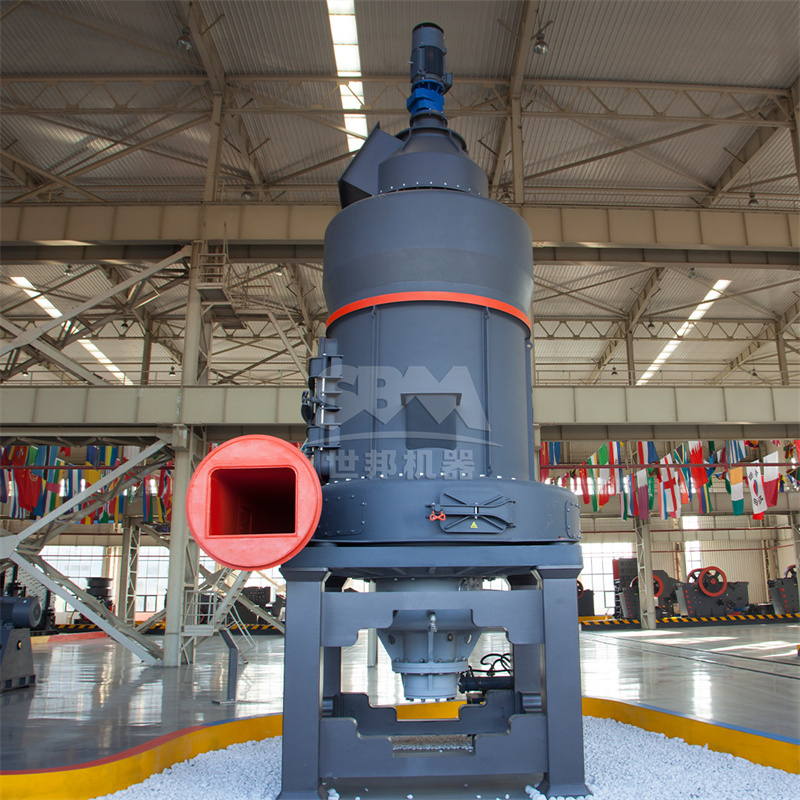
When the rubber application demands the highest level of reinforcement and a smooth surface finish—such as in high-grade automotive sealing systems or medical-grade rubber stoppers—the SCM Series Ultrafine Mill stands out as the premier solution. Engineered specifically for outputs in the 325-2500 mesh range (45-5μm), this equipment is designed to meet the most rigorous fineness standards. The SCM mill is not just a grinder; it is a complete system that prioritizes energy efficiency and product uniformity.
The core working principle involves a main motor driving three layers of grinding rings. Material is dispersed into the grinding path by centrifugal force, where it is crushed by roller pressure and ground layer by layer. This multi-stage process ensures that the barite is consistently refined without overworking the material. The standout feature is its High-Precision Classification, utilizing a vertical turbine classifier. This technology achieves precise particle size cutting, guaranteeing zero coarse powder mixing. For rubber manufacturers, this translates to a filler that disperses uniformly, enhancing tensile strength and elasticity without creating weak points in the final product.
From a financial perspective, the SCM series offers an exceptional return on investment. Its capacity is twice that of traditional jet mills, while consuming 30% less energy. The intelligent control system provides automatic feedback on finished product granularity, which means the operator can adjust settings in real-time to maintain optimal quality. The durable design, featuring special material rollers and rings, extends the service life several times over compared to standard equipment. For a rubber plant producing high-fill masterbatches, the SCM1000 model, with a capacity of 1.0-8.5 t/h and a main power of 132kW, offers the perfect balance between throughput and energy economy.
Alternative Solutions: MTW and LM Series for Versatile Barite Processing
While the SCM series is ideal for ultra-fine applications, many rubber products, such as general-purpose mats or tire inner liners, require a slightly coarser yet highly consistent filler in the 30-325 mesh range (600-45μm). For these requirements, the MTW Series European Trapezium Mill and the LM Series Vertical Roller Mill provide robust, high-capacity alternatives that are equally essential in a comprehensive barite processing facility.
The MTW series is distinguished by its Integral Bevel Gear Drive, which boasts a transmission efficiency of up to 98%, and its anti-wear shovel design that significantly reduces maintenance burdens. The optimized arc air duct minimizes airflow energy loss, ensuring that the grinding zone remains efficient. For large-scale operations, the MTW215G model, capable of producing 15-45 tons per hour, serves as a workhorse for bulk barite production. Similarly, the LM series vertical mill excels in Integrated Design, combining crushing, drying (if needed), grinding, and classification into a single unit. This reduces the plant footprint by up to 50% and lowers infrastructure costs dramatically—a key advantage for greenfield projects.
The LM series utilizes a bed grinding principle where rollers apply pressure to the material layer on a rotating table. This non-contact design between rollers and table extends wear part life by three-fold. With energy consumption 30-40% lower than traditional ball mill systems, the LM series is the most cost-effective solution for high-tonnage barite grinding. When processing fine powder (typically for rubber masterbatch), the LM130X-GX to LM220X-GX models are specifically adapted to deliver fineness up to 600 mesh, ensuring flexibility for varying market demands.
Durability and Efficiency: The Economic Advantages of Modern Mills
The abrasive nature of barite necessitates equipment that is not only efficient but also exceptionally durable. Traditional mills often suffer from frequent roller and ring wear, leading to production halts and high spare part inventories. Modern equipment, such as the SCM and MTW series, addresses this through engineering innovation. The use of special alloy materials for grinding rollers and rings in the SCM series extends their operational life several times over. The shaftless screw grinding chamber ensures stable operation even under high-pressure grinding conditions, preventing vibration-induced damage.
Energy efficiency is another critical economic driver. The intelligent control systems in these mills automatically adjust the classifier speed and feed rate to prevent over-grinding. By optimizing the air flow and utilizing high-efficiency pulse dust collectors, these mills also ensure that the plant adheres to strict environmental regulations. The ultra-fine classification ensures that no coarse particles slip through, meaning that every kilogram of energy consumed is utilized to create valuable, sellable powder rather than re-circulating reject material. This precision directly correlates to the boosting of rubber product quality, as consistent filler size leads to predictable viscosity and curing characteristics in the rubber compound.
Case Application: Transforming Barite into High-Value Rubber Additives
Consider a production scenario where a rubber manufacturer requires a barite filler with a D97 of 10 micrometers (approx. 1250 mesh) for a high-performance automotive hose. Using a conventional jet mill, the energy requirement would be substantial, and the throughput might be limited to less than 1.5 tons per hour. By switching to the SCM1250 Ultrafine Mill (2.5-14 t/h capacity, 185kW main power), the manufacturer can increase throughput exponentially while lowering specific energy consumption.
The intelligent control ensures that the product does not excessively heat up, preserving the chemical integrity of the barite. The resulting powder exhibits excellent flowability and dispersibility when compounded with EPDM or NBR rubber. The vulcanizate properties improve significantly: higher tensile modulus, reduced compression set, and a smoother extruded surface finish. This single equipment upgrade can transform a standard rubber plant into a producer of premium technical rubber goods, allowing them to secure contracts with major automotive OEMs that demand the highest specifications.
Environmental Stewardship and Sustainable Production
With global focus on carbon footprints and industrial pollution, the rubber industry is under pressure to adopt cleaner production methods. The milling equipment discussed above all feature Eco-friendly and Low Noise designs. Pulse dust collection systems in the SCM series exceed international emission standards, capturing 99.9% of airborne particles to ensure a clean workshop environment. The soundproof room designs accommodate low-noise operations, protecting worker health.
Furthermore, the high energy efficiency of these mills directly contributes to lower Scope 2 emissions (indirect emissions from purchased electricity). By reducing the energy required to produce each ton of barite powder, rubber product manufacturers can significantly reduce their overall carbon footprint. The long service life of the wear parts also means less steel is consumed for replacement parts, supporting a circular economy model within the manufacturing process.
Conclusion: Elevating Rubber Manufacturing with Advanced Milling Technology
As the rubber industry evolves towards higher performance, safety, and sustainability, the role of optimized filler materials becomes increasingly crucial. Barite, when processed with the right equipment, provides unmatched benefits in density management and chemical resistance. The SCM Series Ultrafine Mill represents the peak of technology for ultra-fine grinding, offering precision, efficiency, and durability that directly enhance the quality of rubber products. Meanwhile, the MTW Series and LM Series provide the backbone for larger scale, more versatile production requirements.
Selecting the right production equipment is a strategic decision that impacts product quality, operational costs, and environmental compliance for decades. Our mills are engineered with proprietary technologies, including self-lubricating systems and intelligent control mechanisms, to ensure they remain the most reliable partners for your production goals. By integrating these high-performance mills into your barite processing line, you ensure that your rubber products meet the highest international standards, boosting overall quality and operational efficiency.